Showing posts with label gamification. Show all posts

Tuesday, March 4, 2025

How to Ensure Participants Return Promptly After Breaks: Three Proven Strategies


How do you ensure participants return on time after breaks? If you've ever struggled with late arrivals disrupting your sessions, you're not alone. Fortunately, with the right strategies, you can establish a punctuality culture without resorting to rigid enforcement.

Previously, we discussed whether classes should start exactly on time. But once a session is underway, ensuring timely returns after breaks presents a different challenge—one that requires a proactive approach.

When teaching half-day or full-day workshops with breaks between sessions, skilled facilitators consistently ensure participants return promptly. After the initial session, you've established authority and rapport, allowing you to implement strategies that encourage punctuality without creating resentment.

The solution consists of three core strategies that work together to create a culture of timeliness:

Techniques of Teaching: The Strategic Approach to Starting Class


Should a class start exactly on time, even if attendance is low? This is a dilemma many trainers and educators face. While punctuality is a professional expectation, effective teaching requires a flexible approach. Let's explore the best strategy for starting class under different circumstances.

Having worked as a professional trainer accumulating thousands of hours of instruction at major corporations, I've observed that teaching techniques can be deliberately planned and practiced. Though natural talent certainly plays a role, exceptional instruction relies more heavily on technique. The approaches I share represent expertise developed over years in professional training environments where instructional effectiveness directly impacts business outcomes.


Wednesday, January 8, 2025


How to Leverage Expertise, Business, and Mission for Maximum Impact

Have you ever wondered how to turn your professional expertise into both business success and meaningful impact? Over the past few years, I've discovered that three core principles – expertise, business acumen, and mission – can transform how we approach our work and create lasting value. What started as personal insights has evolved into a framework that's helped countless professionals navigate their career journey.

The Power of Integration: A Personal Story

It all began with an unexpected message. My friend Betty, a successful business professional, shared a post that caught me off guard. While thanking people who had influenced her that year, she highlighted something surprising: it wasn't my books or presentation training that impacted her most – it was my weekly newsletter. 

"His newsletter's thoughtfulness surpasses any commercial newsletters I've seen, including major international ones," she wrote. "Sure, he promotes his books, courses, and collaborations, but here's what's fascinating: even though you know it's marketing, you eagerly open it every week." Her observation perfectly captured what I'd been trying to achieve: the delicate balance of sharing expertise, running a successful business, and making a meaningful impact.

Days later, my editor friend commented on LinkedIn about feeling uncomfortable with the business side of publishing – selling books and making money. My response? "I love it, and I take selling books and courses very seriously." This contrast in perspectives got me thinking about how we view the relationship between expertise and business.

Thursday, June 22, 2023

Dietitian Civil Service Examination Classroom and Gamification

In my previous explanation of gamifying teaching through competition rules, I used my typical one-day teaching version in a listed company as an example. However, when it comes to a whole semester course spanning 18 weeks in a school setting, how should it be approached? In fact, the pace of an entire semester's curriculum is an ideal time to implement teaching gamification. It allows for a well-organized and systematic execution of each step in the gamification process.

Now, let's dive into how professsor Liu, a renowned nutritionist and the author of a bestselling book, applies gamification to a relatively dull subject of the civil service examination in a university setting throughout an academic year (both semesters). Through this example, we can explore how she transforms the learning experience into a gamified process, focusing on one of the key elements of teaching gamification: establishing game rules.

Stay tuned to discover professsor Liu innovative approach and learn about the crucial aspects of teaching gamification. Together, we'll delve into the fascinating realm of gamified education and uncover the potential it holds for effective and engaging learning experiences.


Week 1: Establishing Rules

The concept of rules revolves around how the upcoming course will unfold and how gamification can be integrated into teaching. During the first week of the university course,  it is customary to explain the course outline. Professor Liu took this opportunity to not only outline the teaching content for the semester but also discussed the grading criteria. The final exam would account for 60% of the students' grades, while their performance in class would contribute to the remaining 40%. But how would this class performance be evaluated? This is where gamification comes into play.

Now, let's dive into how professsor Liu, a renowned nutritionist and the author of a bestselling book, applies gamification to a relatively dull subject of the civil service examination in a university setting throughout an academic year (both semesters). Through this example, we can explore how she transforms the learning experience into a gamified process, focusing on one of the key elements of teaching gamification: establishing game rules.

In the first week of class, professsor Liu would announce the following rules:

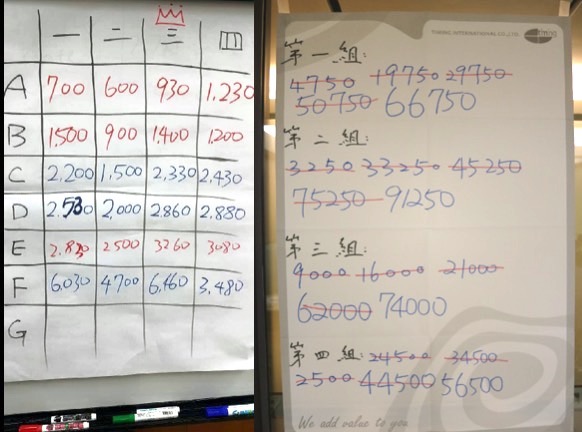
- The course for this semester will be conducted in small groups, with each group consisting of 5 to 8 students (approximately 6 to 10 groups per class). The grouping will be either randomized by the teacher or self-selected by the students, with the teacher then assigning any remaining students to groups.

- Various activities, including Q&A, discussions, presentations, and data research, will take place during the course. Students will earn points by raising their hands and participating, regardless of whether their answers are correct or not. Additionally, extra points will be awarded for correct answers. Volunteering to go on stage for presentations will also earn the group extra points.

- The teacher will keep a running tally of each group's score on the blackboard, and students can see their accumulated points in real-time. Class monitors will record and announce the weekly rankings of each group.

- The final class performance will primarily be based on the rankings of each group. The top 3 groups should achieve a minimum score of 35 out of 40, the 4th to 6th ranked groups should score 30 or above, the third interval should score 25 or above, and the fourth interval should score 20 or above.

- In addition to the group score, individual performance within the group will also be taken into account. The teacher will observe and consult with the group leader and members for assessment adjustments.

These rules will be explained thoroughly in written form and displayed on slides (distributed to students or captured visually). It can be summarized as: Your performance in class this semester will be linked to your grades!

After Week 2: Course Progression

Once the rules are established, the subsequent progression of regular classes becomes relatively straightforward. The second week, which marks the first official day of class, is crucial. Prior to the class, professsor Liu will remind everyone that there will be some Q&A and discussions during certain sections of the teaching. It is important to remember that participation and performance in these activities will directly impact the group grades. With that, the class can commence.

When reaching a natural break in the teaching, deliberately pause and announce, "Alright, it's Q&A time. Raise your hand and answer, regardless of whether your answer is right or wrong, you will earn points. And if your answer is correct, you'll receive additional points. So, regarding what we just discussed..." Proceed to ask some Q&A questions based on the recent teaching material. It could be a closed-book or open-book approach. This way, the content that was just taught can be immediately reviewed, reinforcing the students' understanding.

Beyond Q&A, additional variations in teaching techniques can be introduced, such as group discussions (comprehensive discussions), asking students to research and answer questions on upcoming topics (preparatory reading within the course), or presenting scenarios that combine real-life examples with the knowledge from the textbook. Teachers are likely familiar with the different approaches to crafting questions. After teaching a section, pause for a review session, using various teaching methods to stimulate students' thinking and enhance their understanding. This approach undoubtedly has a positive impact on learning outcomes.

Furthermore, before each weekly class, the part for hand-raising and answering questions can be designed to recap what was learned the previous week. This not only activates prior knowledge but also helps students prepare for the upcoming week's learning. Through gamification techniques, it quickly directs students' focus into the classroom. Similarly, a similar Q&A review can be conducted before the class ends, allowing students to reflect on their learning in that particular session. Multiple reviews like these greatly aid in reinforcing students' memory.

Unforeseen Effects

Through an interview with professsor Liu, it was revealed that the original course, being a specialized subject for national exams, consisted of a significant amount of memorization and had the pressure of keeping up with the pace. Consequently, the previous class format tended to be lecture-based, making the classroom atmosphere somewhat dull.

However, when introducing gamification into the curriculum and linking the performance of the group teams with their regular grades through the established rules, there was a noticeable increase in student engagement and attentiveness. Q&A sessions and discussions in class were no longer met with silence after posing a question; instead, when the teacher asked a question, students eagerly raised their hands to answer! After all, every participation earned them points, and the more guesses they made, the more opportunities they had! In topics that required book referencing, it was observed that students would remain quiet, flipping through their books, and as soon as the time was up, numerous hands shot up in the air. This level of active participation was not often seen in traditional university classrooms!

Of course, there were still some students who, regardless of gamification, remained their usual "quiet" selves. To encourage participation, professsor Liu sometimes incorporated random selection activities, where students with specific student numbers like 6, 16, 26 would come up to the blackboard! However, if the selected student faced difficulty, other team members were allowed to provide assistance. This ensured that every student in the class had an opportunity to participate.

What was even more interesting were the unforeseen effects! Some students who may have had lower grades or struggled with presentations or memorization found their place to contribute in the gamified teaching process. For example, they might take charge of raising their team's hand to earn points or play the role of discussion paper holder during presentations, or even become the main presenter themselves. As the game revolved around team rather than individual rankings, it actually motivated individuals to perform better. Their efforts were no longer solely for their own benefit but for the overall performance of the team, leading to subtle shifts in the class's participation dynamics. This was a transformation that Professor Liu hadn't initially anticipated.

Conclusion

If we can transform a dull national exam course into an engaging gamified teaching experience, then based on  professsor Liu's gamified classroom experience, we should question whether the limitations we impose on gamifying our curriculum are genuine constraints or self-imposed limitations.

However, the most important factor is not whether the course is fun or whether students participate but rather the learning outcomes of the students. At least, with the gamification drive, the students' level of focus has increased, and the participatory review at each stage of the course, as well as proactive previewing, have greatly enhanced the learning outcomes.

All of this begins with a fundamental key: establishing the rules for gamifying the curriculum! Taking Professor Liu's example, we can observe three basic rules:

1. Linking class participation with regular grades (gamified reward, "Benefit")

2. Team-based scoring with weekly rankings (gamified points, "Points," and leaderboard, "L," as well as team-oriented competition)

3. Many interactive discussions throughout the course where any participation earns points, and correct answers are rewarded with higher scores (linking instructional format with gamification and creating a risk-free environment)

Of course, behind these exciting teaching methods, a significant amount of preparation time is required! If only textbook content is delivered, the pre-class preparation is relatively straightforward. However, to make the course more engaging, Professor Liu must transform a lot of subject matter expertise and incorporate gamified teaching elements into the entire semester while balancing progress and effectiveness. This means she needs to invest additional preparation time to design the course! Many times, it requires early mornings to prepare and think about the activities for the entire class. However, it is gratifying to see that these efforts yield results. Students are more engaged, focused, and they learn better. The course is no longer solely the teacher's solo performance but a classroom co-constructed by the teacher and students.

After reading this gamified teaching example in a university classroom, has it sparked any different ideas in your mind? I also welcome you to share your thoughts with me! Once again, I would like to express my gratitude to professsor Liu for sharing such an excellent gamified teaching example.

If possible, I also hope that more primary and secondary school teachers can share with me: how do you gamify your classrooms? Feel free to leave a comment or send me a private message. You can also self-recommend or recommend others. Perhaps your classroom will soon appear in A-fu's gamification series of articles or even in a future book!


Wednesday, June 21, 2023

From Lack of Engagement to Immersion - Techniques for Delivering a Speech to High School Students: Gamification


Delivering a speech to recently announced high school students, who are still dealing with the emotions of their college entrance exam results, presents a significant challenge. How can we quickly deliver a speech that not only provides reassurance but also inspires them? As someone who usually delivers speech to adult within the corporate world, this was truly a new challenge for me. However, it seems I did well! As one student put it, "I walked into the audio-visual classroom with tears still in my eyes in the morning but left with a satisfied smile" (quoted from student feedback). There was even a student who expressed in their post-session reflection, "Your words gave me great motivation and inspiration... It's a lifetime blessing to have the opportunity to hear your speech!" (Reflection shared on Facebook, rest assured it has nothing to do with grades XD). How was this type of learning experience created? Let me recreate the scene and break it down step by step, so you can understand my thought process behind delivering a speech. Perhaps in the future, you will also have the opportunity to create remarkable speeches or courses for different audiences.

Change Perspectives, Predict Outcome

Before every class or presentation, I always take a moment to imagine, "If I were a student sitting in the audience, what would I be thinking? What takeaways would I hope to gain from this experience?" Adopting this perspective can be highly beneficial when planning and setting goals for the session. Reflecting on my own high school days, I imagine facing a middle-aged speaker on stage and contemplating:

 "Who is this person? Is their content worth listening to?"

 "Are they here to preach at us?"

 "Can I apply their experiences to my own life? How would it benefit me?"

 "Can I realistically achieve what they're sharing, or is it only attainable for a select few?"

With this exercise in empathy, I quickly realize that the content I previously prepared for corporate training programs wouldn't resonate with high school students. It would seem too distant from their current reality. Having just finished their college entrance exams, they may not even know which university they'll attend. Sharing workplace or societal experiences would feel far removed. If I were to proceed with such content, they might acknowledge my expertise, but it wouldn't be helpful to them. Therefore, I need to consider the points of connection and reflect on the influential concepts that shaped my journey from high school to the present. Instead of lecturing, I must engage them by inviting their participation in key decision-making moments in my life. Through interactive discussions and simulations, they can gain a more authentic and relatable experience.

Lastly, it's crucial to provide practical everyday techniques that they can genuinely use and take with them, rather than leaving it as a mere lecture.

With these thoughts in mind, I begin investing time into designing this two-hour presentation.

Grabbing Attention and Establishing Credibility

Whether it's high school students or professionals, the first few minutes of a class or presentation are crucial in immediately capturing everyone's attention. Otherwise, distractions like smartphones may make it difficult to regain their focus. It's not just about grabbing attention; it's also about establishing credibility and conveying the value of the session, making everyone feel like it's worth their while.

 I showcased several guest speakers I had invited before, including dietitan, dentist, orthopedicist, Spanish teacher and   physical therapist. By refreshing everyone's memory and mentioning these individuals, I pointed out two commonalities: first, they are all friends of mine, and second, they have attended my training courses, which essentially makes me "their teacher" (please forgive me, esteemed teachers, for the effect I created in front of the students XD). With this introduction, everyone's eyes lit up.

Next, I engaged the audience by asking them to guess which of the teachers in the pictures, including myself, had the worst grades in high school. The answer, of course, was me! I showed pictures of myself during my vocational college years, as a construction site supervisor, and as an insurance agent, followed by a comparison with my current appearance (quite a contrast, don't you think? I mean, in terms of physique XD). The students found it more interesting and quite a drastic change. Some even exclaimed, "A- fu used to be so skinny!" (Come on, I quickly replied, "I'm still skinny now! Just with an additional 30 kilograms! Don't laugh, my dear classmates, you'll become a 'well-rounded' adult just like me in 10 years!" XD).


With such an opening, students became curious about my "superstar" teachers and how I went from being an underachiever in high school to where I am now. Their attention immediately focused on me, didn't it?

Decision-making and Constructing Learning

When we were young, we often carried a rebellious attitude, thinking, "I already know all this... Stop nagging!" Despite our well-intentioned advice, it was often perceived as preaching. I don't want to spend my time in high school listening to a nagging uncle! Words spoken may be forgotten, but what about active participation in decision-making? Perhaps that's what helps us remember things better?

With this idea in mind, I turned several important decision points from my youth into multiple-choice questions with three options. For example, during my first year in vocational college, I was interested in computers and seriously considered, "Should I change my major?" The options were "Definitely switch," "No, it would be a waste of a year," and "Double major." I posed the question to the high school students in the audience. The discussions erupted with everyone expressing their opinions passionately! Some said, "Definitely switch" (now I know the answer, but back then, I had no clue!), and others said, "Double major" (if only I had been that serious when I was young!). Finally, I revealed my choice: "No, it would be a waste of a year." The students found it amusing and thought I was naive (Wait, wasn't I their teachers' teacher?!). However, it helped them understand that everyone has limited perspectives when they are young. Instead of lecturing, the students could experience and deeply feel it themselves.

Similar decision-making scenarios included "Finding my first job," "Whether to switch jobs," and "My mother's opinion." Instead of providing the answers upfront, I invited the students to participate in the decision-making process. Afterward, we revealed the actual answers. It didn't matter if their choices were right or aligned with mine. Every decision became a learning opportunity. The group decision-making and learning process fostered tremendous engagement and joy among the students!

Condensing Experiences, Summarizing Key Points

To enhance the focus of learning and ensure that students take away what I want them to, I not only involve them in decision-making but also share my life experiences. In the end, I condense these experiences into "one sentence" to provide children with a concentrated and essential learning point.

For example, I shared how even though I couldn't bear to waste a year during my vocational college years by switching to an information-related major, I continuously learned about computers, built websites, and authored computer books. Eventually, when I approached the age of 40, almost 20 years later, I went back to school and earned a doctoral degree in "Information Management." Seizing the moment when students expressed astonishment, I condensed it into one sentence: "Don't let a degree limit your learning!" I hope that regardless of the degree they pursue or the school they attend (as I know their high school exam results have just been released), they won't allow external factors to restrict their learning. This sentence became one of the most memorable phrases in the students' reflections.

In alignment with career choices, I mentioned the importance of being brave but not impulsive, and of gaining the trust of family while following one's own path. After sharing experiences and showcasing real photos, I emphasized and condensed these key points. From the students' reflections and takeaways following the speeches, I knew they took something with them. Here are a few examples:

"I loved the sentence 'You don't have to fall in love with school, but never stop learning.' It's my favorite from this speech, and it resonates deeply with me." - Student Dai.

"To be honest, I wasn't in the mood to focus and listen attentively to this hard-earned speech. But magically, after hearing Uncle Fu's humorous opening remarks, I gradually shook off my previous unpleasant mood and followed A-fu's step by step into his three moving stories." - Student Du.

"Listening to A-fu's  speech helped me gain a clearer direction for my future university choices." - Student Chang.

"What impressed me the most was the choice to be brave but not impulsive." - Student Shang.

"However, after A-fu started his speech, the atmosphere he created instantly drew me in, causing me to forget my previous unhappiness." - Student Wang.


"This speech was different from others that are usually very serious; it made me laugh while teaching me lifelong lessons." - Student Ye.


"After listening to A-fu's  speech, I became more certain of my own willpower and affirmed my own value. Your words gave me great motivation and inspiration."

Pre-class and Post-class Implementation Exercises

I am well aware that sometimes there can be a disconnect between being moved in the classroom and taking no action once back home. To ensure that students truly take something away from this speech, I collaborated with Fairy Teacher to design different learning activities for both before and after the class. One of these exercises was the "50 Life Dreams" practice. If it were only discussed in the classroom, it would merely be glanced over without deep understanding. So, I asked Fairy Teacher to treat it as a worksheet and had students practice writing their dreams before the speech. Here are some student reflections:


"The exercise of 'writing down the 50 things I most want to accomplish in life' made a deep impression on me, and it made me want to work hard to achieve them. I stopped at around 40-something dreams..."


"The seemingly easy worksheet ended up taking me nearly two hours. I thought I could finish it easily, but by the time I reached the 36th dream, I couldn't think of any more. My mind was completely tied up..." - Student Liu.


"While writing the fifty dreams, I remembered my desire to study in Germany... Staring at the remaining empty spaces, I took a deep breath and told myself, 'Give it a try, write it down.'" - Student Liu.


Of course, I also want to express gratitude to Fairy Teacher for encouraging students to think broadly, and through the process of inviting me, they did their own homework and even made thoughtful cards. The focus isn't on the external forms, but rather on designing activities that engage students' hearts. This approach leads to better overall learning outcomes.

Conclusion

In this brief reflection on the speech given to high school students, I revisited the reflections written by the students and even read the heartfelt thoughts of teacher yu's daughter,Ann, who wrote, "Our success is determined by ourselves, and no one can decide everything for us." She also noticed, "I discovered that Uncle Fu and our mom are alike. They both divide the groups, choose group leaders, and select a student responsible for keeping score. They almost use the same approach"(Haha, you caught me!). It made me realize that the effort I put into preparing for this speech was truly worthwhile.

The important question is: Did you notice which learning theories we applied throughout the entire speech? How did we guide the students into the learning context? Why did these actions prove effective for students who were feeling down and not in the best state of mind after their examination results? And how can we explain it using learning theories?

We will delve into these topics in future articles, so stay tuned!


Thursday, June 8, 2023

Most important element: Integration with training goal


Let's start with a guessing game: Over the past two years, nearly 40 teachers who have implemented gamification in their classrooms participated in research interviews with me. Spanning across different teaching topics and student demographics, they unanimously agreed that the most important aspect of gamification in teaching is “___”.

 What do you think fills in the blank? Is it P.B.L: Points, Benefit, Leader Board? Or is it motivating learning? Grouping and competition? Or something else? Take a guess, what do you think it is?

 The answer is: “Integration with training goal!”

 The answer may sound simple and obvious. However, before writing this article, I posted the question "What is the most important key to gamified teaching?" on Facebook. Within two hours, there were nearly 60 comments. Among all the comments... only fewer than 10 mentioned " Task with challenging goals" or "learning feedback." The success rate was less than 20%. Nevertheless, thank you all for your participation!

Ensure your Training Goal

This actually reflects something: many people overlook this crucial key when implementing gamified teaching! And that key is "What are your Training Goal?"

 Many teachers, when first exploring innovative teaching methods or gamification, often get entangled in flashy and fancy appearances or techniques. They believe effective teaching entails a high level of interaction, capturing students' attention, and utilizing multimedia aids, among other things. As a result, I sometimes witness classrooms where teachers employ techniques such as question-and-answer sessions, discussions, bonus points, competitions, and more. While these activities may be engaging and lively, when I pause and reflect, I often find myself questioning the purpose behind the interactions and the learning outcomes they bring.

Speaking of which, recently, I've been contemplating gradually moving away from relying solely on Facebook for sharing my content. However, I don't want my new articles to go unnoticed. So, if you'd like to stay updated on my latest articles, please subscribe via email. Your support is the greatest encouragement for me to continue writing.

 Now, let's get back to the main point of the article.

How to design a good Training Goal

Let's review for a moment. In my book " The Techniques of Teaching " and the online course, I consistently emphasize the importance of determining your training goal. A good teaching objective is something that can be immediately validated and assessed in the classroom. It answers the question: What do you want students to take away from the lesson? What specific changes or gains do you expect? And most importantly, it should be something that can be directly measured or observed at the end of the course.

For example, let's consider a course on "Time Management" (I often use this as an example because it is interdisciplinary and seems to be a subject everyone needs). If the goal is set as "Increasing personal productivity and competitiveness" or "Changing mindset and perspectives," although these objectives are positive, they cannot be immediately evaluated after the lesson. Therefore, they do not qualify as good teaching objectives. However, if we revise them to "Learning the techniques of sticky note prioritization and the Pomodoro Technique" (which can increase personal productivity and competitiveness) and "Teaching the important/urgent matrix" (which can lead to a change in mindset and perspectives) ... objectives that are specific and measurable like these would be considered good training goals.

 Remember, setting clear and assessable teaching objectives is essential for effective instruction.

Integrate training goal with gamification

Once the teaching objectives are established, we can begin incorporating elements of gamification into the course design and activities to stimulate student interest, capture their attention, encourage participation, and enhance learning outcomes. These are the steps taken after confirming the teaching objectives.

Taking the example of the "Time Management Four Quadrants Matrix," in traditional instruction, the teacher would introduce the concept of the four quadrants, dividing tasks into important/unimportant (horizontal axis) and urgent/not urgent (vertical axis), emphasizing the need to prioritize important and urgent tasks, followed by important but not urgent tasks, and so on. After the explanation, students would nod their heads in understanding... and then promptly forget it.

With the use of gamification, we can start by having students work in small groups to brainstorm the tasks they typically encounter in a day. Then, they can use sticky notes to place these tasks on the four-quadrant matrix. Next, they transfer these tasks onto a daily calendar (since sticky notes can be moved around without repetition, this eliminates the need for redundant work, which should be planned in advance during course design). To enhance motivation during the process, we can incorporate question-and-answer sessions where participants earn points for their responses. The calendar design can be turned into a competition, with the teacher or peers providing evaluations to differentiate scores. Additionally, tangible or intangible rewards can be offered to ignite intrinsic motivation using external incentives. All of these methods revolve around the initial training goal and are designed to gamify the teaching approach.

Based on my experience in expert interviews, I have witnessed teachers designing various gamified activities to achieve different goals. For instance, to help caregivers understand potential problems and their solutions in a home setting, a teacher created a 16-square grid where participants collected answers and transformed them into a bingo game. In another case, a teacher aimed to familiarize students with behavioral traits associated with different personality colors, so they designed a betting wheel where participants placed bets on the personality type that matched a given behavior description. Furthermore, to encourage hesitant students to link pronunciation with word meaning, a game was created where participants enthusiastically used sticks to smack answer to answer the questions (everyone were into it. Thanks for the creativity of Teacher Yolanda). Lastly, I designed increasingly challenging competitions with higher scores to inspire participants to deliver outstanding performances on stage.

Gamification is just a Method. The Key Point is to reach the Training Goal

"Don't gamify just for the sake of gamification." "Design training goals and gamification strategies based on your instructional objectives." "Gamification is merely a surface-level approach; learning is the key!" These are the most frequently mentioned statements from the interviewed teachers!

But wait, why make it so complicated? Why not just deliver the content directly? It saves time and is efficient, right? I've asked this same question to many different teachers, and their response was along the lines of, "I prioritize teaching effectiveness over efficiency. If students learn quickly but also forget quickly... I'd rather teach less, teach slower... but ensure they remember forever." This brings us back to the key point mentioned earlier: What are your instructional objectives? Why are you teaching this class? Is it about completing the lesson or truly educating the students? And after educating them, what do you expect them to learn? What changes do you hope to see? Perhaps these questions are at the core of teaching, things we should prioritize and plan for.

Feel free to explore the following research papers for further insights, which may provide valuable tips to enhance your teaching practices:

Research on Gamification in Education - English Version: The key elements of gamification in corporate training – The Delphi method

Thursday, May 25, 2023

PBL (3) Gamification- Point, Badge, leaderboard


The three essential elements of gamified teaching are: Points, Benefits, and Leader Boards. We have already discussed how to plan the points mechanism, encouraging teams through scoring and differentiating scores throughout the process, and linking it to the reward system. In this final article on gamified teaching, let's talk about the last element of gamification: the Leader Board!

Leader Board

Leader Boards are commonly seen in games, starting from old single-player games where your score would be compared to others' after each play session, determining your ranking. Some games even allowed you to enter your name using a joystick or keyboard (remember those days?). With the advent of online gaming, Leader Boards have become ubiquitous. For example, in the gamified application Nike+, Leader Boards are integrated with running distances. We often see friends competing against each other in rankings based on their running mileage in Nike+. In this example, running mileage is akin to accumulated points in class, reflecting the efforts made during the process. And when comparing these results with others, the relative value is determined, which is the purpose of a Leader Board!

However, don't assume that a Leader Board is merely about tallying scores and announcing rankings. To effectively implement a Leader Board, there are several important key points to consider!

PBL (2) Gamification- Point, Badge, leaderboard

In the previous article, we discussed the three core elements of gamifying education: Points, Benefits, and Leaderboards, abbreviated as PBL. Interestingly, another application of PBL in education is Problem-Based Learning, which is frequently mentioned in educational research and widely used in case-based teaching, business management, medical education, and other related fields. So, PBL is indeed a fantastic abbreviation!

Last time, we talked about the P - Points, including scoring calculations and operational details. Now, let's move on to B - Benefits and L - Leaderboards, and explore how they can be implemented.

Benefit

In some early studies on gamification, the "B" stood for Badge, referring to the concept of earning badges as achievements. This was inspired by early gamified applications like the FourSquare check-in game, where different check-in times earned different badges. Many games also have a leveling system, such as progressing from a Bronze Knight to a Silver Knight, Gold Knight, and finally a Platinum Knight. Some researchers even explored applying this badge mechanism to classroom teaching, creating virtual levels where students who performed well, participated actively, or submitted excellent assignments could accumulate points and level up. For example: Silver Good Student > Gold Good Student > Platinum Good Student... However, the research findings from experiments showed that "there was no significant impact between the badge system and student performance."

I couldn't help but laugh when I read about this study (Sorry, I should maintain academic impartiality XD). Applying badge systems in educational settings, of course, doesn't work! It's much better if adult learners are collecting precious stickers and trading them for cool badges!

PBL (1) Gamification- Point, Badge, leaderboard


Applying the core elements of games in non-gaming environments is what we call "gamification" (Deterding, Khaled, Nacke, & Dixon, 2011; Huotari & Hamari, 2012… Yes, I really do read!). Therefore, gamification is not a game, it's not computer-aided instruction, and it's not so-called situational simulation (like flight simulation). The focus of gamification is to extract the crucial elements that make games fun, apply them to different domains, to increase user engagement, stimulate investment, and even boost performance. (As this isn't an academic paper, I will forego further citations).

So, can corporate education and training programs really be combined with gamification? Many corporate training programs are not only professionally content-heavy, but the learners are professionals themselves. Can gamification really impact this group of corporate executives and increase their participation and investment? The answer, of course, is a resounding: Yes!

Without personal experience, you might find it hard to believe: a vice president of a publicly listed company, while being in the same group as the director and managers in the early stages of a course, exclaimed, "Let's do our best, and I hope to bring this building block home for my son to play with!" (Everyone felt the pressure instantly). It's also hard to believe that HR said their engineers always had a dull atmosphere in their classes but would fiercely compete and eagerly raise their hands for extra points. And during the breaks of each class, groups would gather around the scoreboards to discuss the latest standings. These behaviors from the participants were beyond what HR could have imagined, and they would often ask me, "Teacher, do you have some kind of magic? Why do our engineers become so engaged and participate so actively?"

It's not magic; I simply incorporated three core elements of gamification into the course: P.B.L.!
I meticulously designed the gamification of the curriculum!

Following the explanation in the book "Practical Gamification" by Zhou Yuka (2017), the three core elements of gamification, P.B.L., refer to points, badges, and leaderboards. However, based on my practical experience, I decided to change badges into benefits. So, in the FuGe edition of gamification, P.B.L. stands for points, benefits, and leaderboards (Wang Yongfu, 2018... Please remember the citation XD). Now, let's delve into how to implement the three elements of gamified P.B.L. in the curriculum:

Monday, May 22, 2023

Case Study: Medical Law 101 - Gamification in Specialized Course Teaching

A classroom is filled with medical personnel, attentively listening to a lecture on medical law taking place at the front of the room. Speaking strictly, the definition of "medical routine" alone is highly specialized, let alone delving into the "legal judgment of medical routine". This field straddles both "medical" and "legal" expertise, and only a handful of experts are capable of lucidly discussing its intricacies. One such expert is Dr. Kun-Ren Yang, affectionately known as 'Emergency Big Brother'.

Afternoon class on "Medical Routine and Legal Practice"

Dr. Kun-Ren Yang, an emergency physician by profession, also holds a Master's degree in Law. He is well-versed in medical dispute resolution processes and legal rulings. Not only does he lecture medical colleagues, but he has also led discussions on medical disputes and cases with lawyers, and has published "The 40 Mandatory Medical Lessons Not Taught by Teachers", which delves into real medical cases and court judgments. The audience for this particular day's lecture were medical colleagues from other hospitals. The class took place at 2 p.m., and the topic was "Medical Routine and Legal Practice". In the face of such specialized content (medical expertise + legal expertise = super specialization), specialized students (doctors, nurses, hospital administrators), and challenging time slot (2 p.m. to 4 p.m.)... how do you think the class proceeded? What was the classroom atmosphere like? Was it the teacher explaining the laws segment by segment on the podium while the students nodded off below, or was everyone drowsy and unresponsive?

The actual situation would surpass your imagination! The scene was such that as soon as the teacher asked, "Is this surgical consent form valid?" a bunch of students immediately raised their hands, eager to answer. A while later, everyone, following the teacher's instructions, quickly picked up their phones to search for the "elements" (necessary conditions) of a surgical consent form, trying to be the first to answer the new question that the teacher raised on the slide... Yes, even though they were all scrolling on their phones, what they were scrolling through were legal texts, diligently searching for questions related to medical regulations.

You probably can't imagine that a course on medical and law can be taught in such an engaging and interesting way?

Tuesday, April 25, 2023

What are the differences between Teaching Gamification, Game-based Teaching, and Educational Game Software?


Upon seeing the words in the title, such as "gamification in teaching," "game-based learning," and "educational game software"… I'm not here to play tongue twisters or games with everyone. In the following article, I will clarify these terms.

The reason I want to write this article is that in recent years, as gamification has gradually become popular, different teachers have different interpretations of gamification in teaching. Some teachers have started to incorporate games or activities into their courses, allowing students to learn through games; some teachers have turned courses into challenge games, deeply integrating games with the curriculum; some teachers have brought board games into the classroom, transforming the curriculum into board games; even more impressive, some have combined stories, scenes, and escape rooms, resulting in large-scale and well-designed learning games.

Another gamification faction believes in software, asserting that gamification in teaching should be combined with software or apps. From the simplest use of software for scoring and ranking or utilizing apps for quizzes, interaction, and testing, to further using game simulations or situation simulations; I've even heard of teachers planning to combine VR applications… These are all amazing.

However, the two developments mentioned above – educational games or game-based learning (not gamification, as I will explain later), as well as gamification in teaching through software – seem to have encountered bottlenecks for many teachers when starting. Many teachers are wondering: "I don't know how to transform teaching into games, nor do I know how to incorporate games into teaching. Some rigid knowledge or skills are not easy to package into stories, let alone software or apps."… Can gamification in teaching still be implemented under such circumstances?

Of course, it can! Because gamification in teaching, game-based learning (or learning through games), game simulation teaching, and gamified software… Although the words are similar, the meanings are quite different.

Sunday, April 23, 2023

Teaching Techniques: Gamification is Not Group Bonding Activities


In a Train the Trainer session, a teacher asked me, "Should groups have team names during group activities? Should they have a team cheer? When everyone's present, should they all raise their hands and shout together? Should they encourage each other with hugs?"

These are great questions! They instantly reminded me of my college days participating in outdoor activities (hiking trips, river treks), where we formed teams with names and cheers, and announced our presence together. Those memories are vivid and beautiful. However, corporate training is not outdoor activities! As I've mentioned before, the atmosphere in most corporate training sessions is initially cold, and interaction between the trainer and participants is weak. If you try to forcefully create a lively atmosphere by adopting team-building activities, like team cheers or shouting together, it's hard to imagine what the scene would look like at the beginning (this doesn't apply to experiential courses or outdoor activities).

Thursday, April 20, 2023

The Art of Teaching: How to Inspire Participation and Motivation through Gamification (Part 1)


Many teachers, when learning teaching techniques, encounter their first obstacle: "It's useless! They don't participate in the teaching activities I design!" "Whenever I ask the students anything, they don't move and just silently watch me." "Group discussions? They don't even discuss! Many are just chatting, presenting something random on stage, and then quickly stepping down." I believe this is a major challenge faced by many teachers and lecturers!

Let me first clarify that even for professional trainers whose participants come from large corporations, the attitude before the class is quite similar. Over 80% take a neutral or defensive attitude towards the upcoming course. We have already briefly described this in a previous article. If you don't believe it, the most common pre-class scenes I've encountered during my past ten years of experience include:

"I've been busy lately; I want to finish my work first." (Status: computer open)

"Who's the teacher? What class is this?" (Status: flipping through the lecture notes)

"Why am I assigned to this class? Do I have any problems?" (Status: visibly unhappy)

"I'll find a better seat later, so the teacher won't call on me." (Status: sitting further back)

"Don't bother me; I'm in a bad mood!" (Status: not even looking at the teacher)

Not to mention that in many high-tech companies, engineers tend to have a cold demeanor (calm? cold-hearted? XD). The initial "intimidating" and "silent" atmosphere can send chills down the spines of lecturers on stage. In other words, encountering unresponsive students at the beginning of a class is a daily routine for corporate trainers! (Note: Participants in public classes are generally more enthusiastic since they paid for the course themselves. Teaching public classes feels like a vacation for professional trainers XD)

How to Ensure Participants Return Promptly After Breaks: Three Proven Strategies

How do you ensure participants return on time after breaks? If you've ever struggled with late arrivals disrupting your sessions, you...